
You can hire a top SaaS sales rep in under a week. What kills quality in fast SaaS sales recruitment is a lack of clarity, and more time won't give you that. Hand a hiring team a longer deadline and they'll stretch the process to fill it, adding rounds and opinions without lowering their risk at all.
Companies can hire in 48 hours or less when every step is planned ahead, they know exactly what good looks like and candidates get a great experience. For a sales rep, that means most of the week's work happens before anyone is interviewed. A one-week hire won't happen on every role, because some roles are hard to fill and some markets are tight.
Key Takeaways
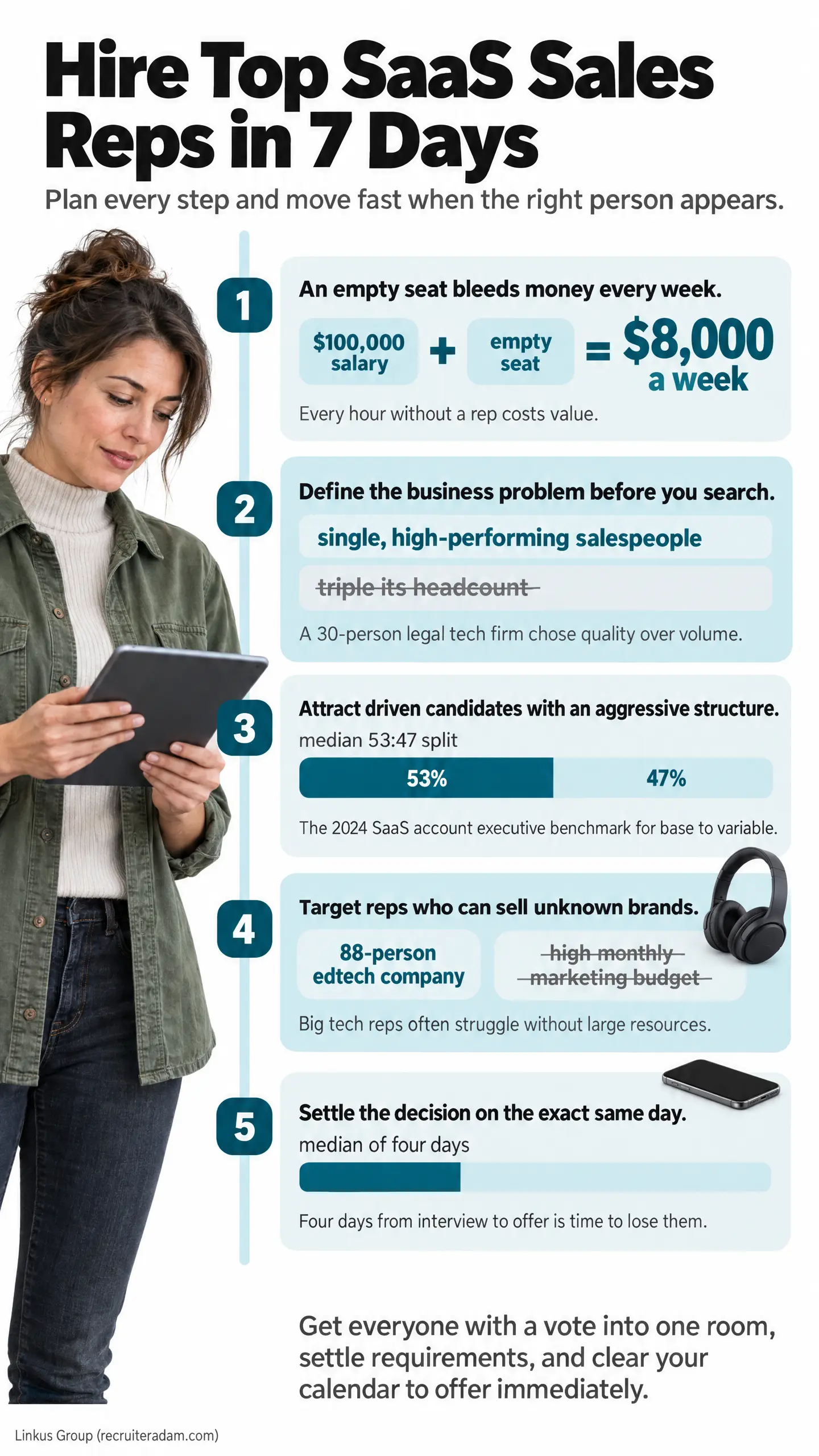
- Leaving a SaaS sales seat empty for a representative with a $100,000 salary costs a company approximately $8,000 per week in unrealized revenue.
- Bridge Group's 2026 research indicates the average SaaS Account Executive requires 6.2 months to ramp up to full sales productivity.
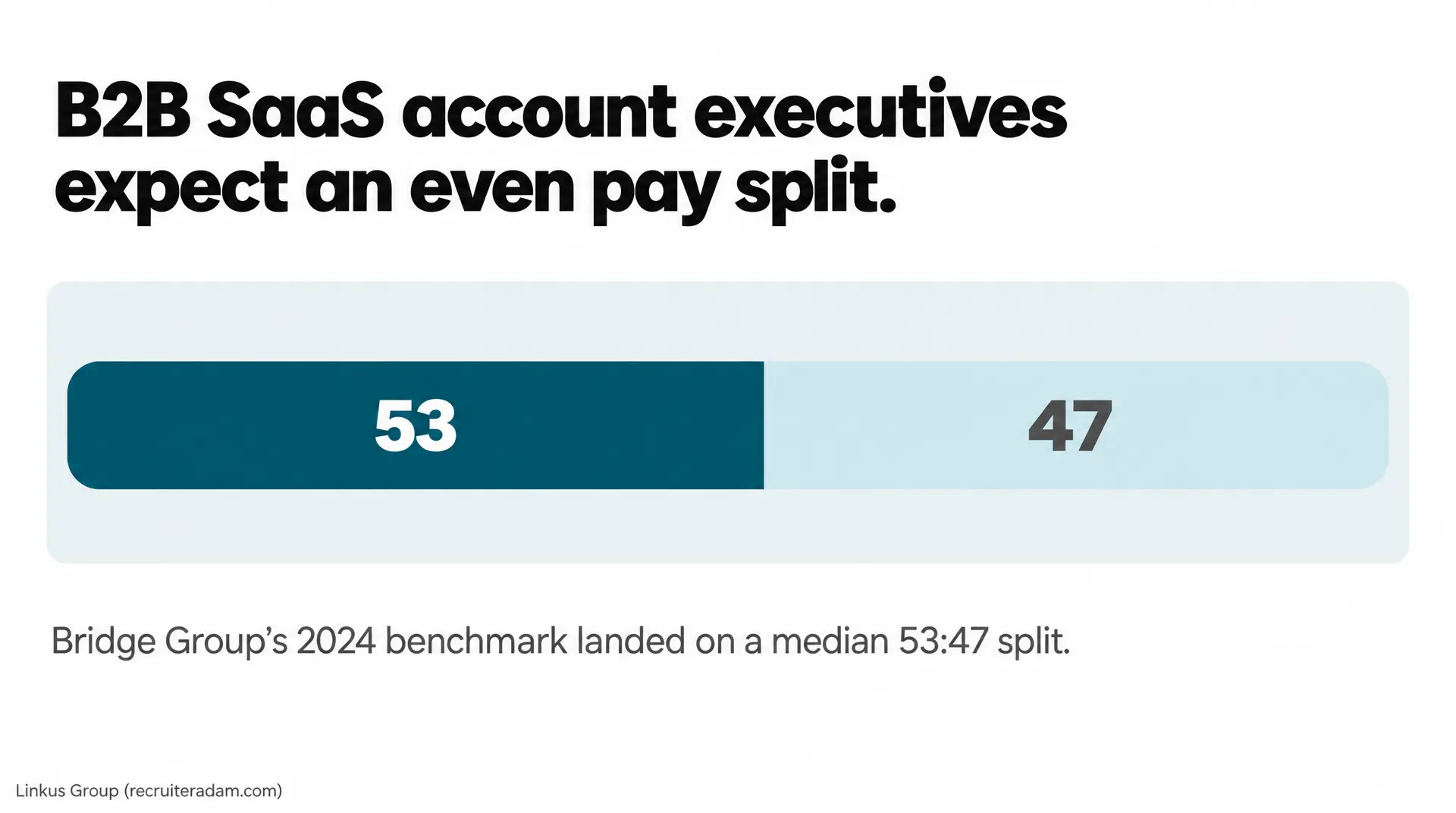
- Bridge Group's 2024 benchmark reveals that B2B SaaS account executives operate on a median 53:47 compensation split between base salary and variable commission.
- ERE's 2023 CandE research identifies delayed hiring processes, disrespected time, and misaligned pay expectations as the primary reasons sales candidates withdraw from consideration.
- Sales representatives recruited from large technology firms frequently fail at early-stage startups because they rely on established brand recognition and high monthly marketing budgets.
- Linkus Group maintains a 96% candidate retention rate at 18 months by detailing daily job challenges during interviews and coaching clients through onboarding.
What Is the Financial Cost of an Unfilled SaaS Sales Rep Position?
"Hire slow, fire fast" is the biggest lie ever told in hiring. If you hire really well, you won't need to fire, and if you're slow, you never land the right person at all. For a company under 250 people, speed is the biggest asset it has, and with a sales seat you can put a number on what going slow costs.
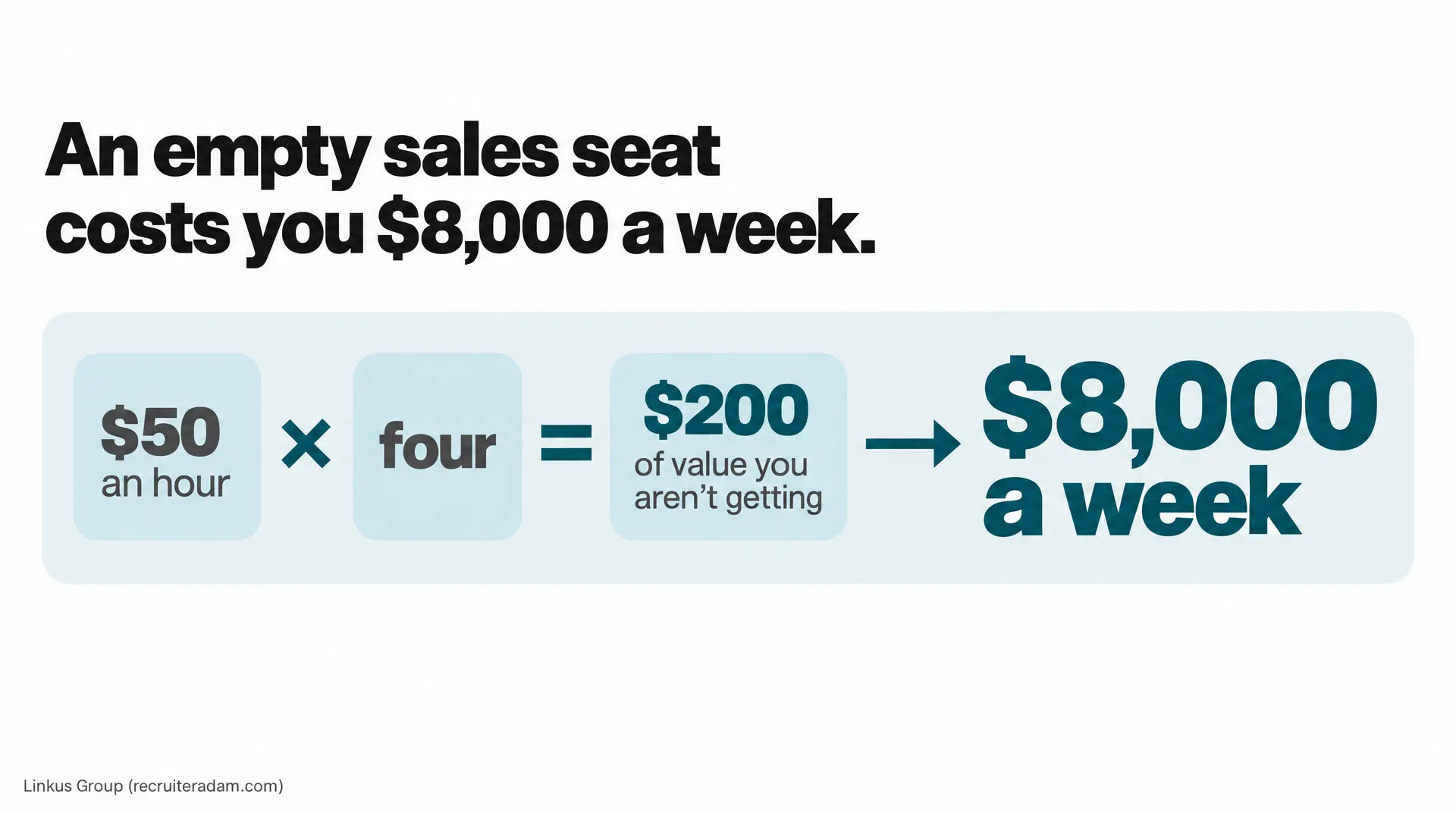
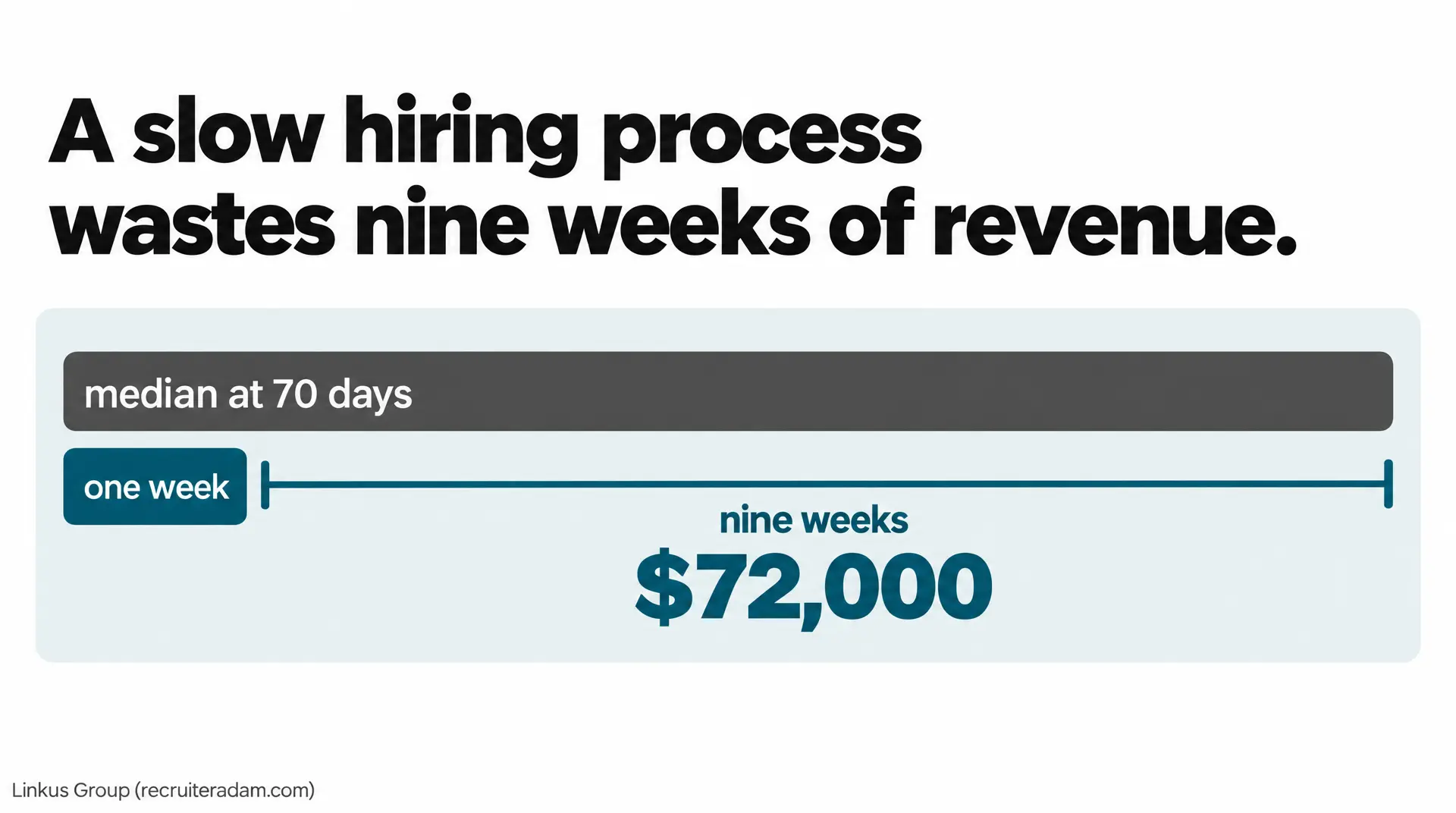
A $100,000 salary works out to $50 an hour over 2,000 working hours. A great hire should bring back three to five times their salary. Call it four, and every hour the seat sits empty is about $200 of value you aren't getting. That's roughly $1,600 a day and $8,000 a week. McKinsey's 2026 HR Monitor puts the median at 70 days from approving a role to an accepted offer. Hiring in one week instead of 10 gives you back about nine weeks, which is roughly $72,000 on my estimate.
A new account executive won't deliver that from day one, since Bridge Group's 2026 research has the average AE ramp at 6.2 months. The ramp starts when the rep does, though, so every week of searching pushes back the day they hit full speed. None of this counts the people covering the seat, who burn out and sometimes leave.
Going slow can also cost you business outright. One company won a major bank contract and lost the project to a competitor, because their interview process wasn't lined up with the project's timeline and they couldn't hire the three people it needed fast enough. A slow process tells candidates you're disorganized, too. Another company stalled on hiring a highly prepared Head of Sales candidate because they said they were too busy, which signaled the role wasn't a priority.
How Should Founders Define the Business Requirements Before Hiring a SaaS Sales Rep?

A job is really just a business problem the company needs solved. Strip a sales seat to the basics and the problem is getting someone who can sell to your customer better than anybody in the company has before. Before anyone looks at a candidate, I want straight answers from the founder. If you didn't add anyone today, would you improve tomorrow? What stops moving if this seat stays empty? What does this rep have to deliver, in numbers, for you to call it a win? What's the full pay plan? Who makes the final call?
If you haven't found product-market fit and worked out which sales motion actually works, hold off on a full-time rep. An employee is never going to sell the same way a founder will. Once the motion is proven, your founding salesperson is there to multiply your time in sales.
Hiring each rep fast is different from hiring lots of reps fast. When investors push for headcount, I'd rather see one excellent rep on a higher salary than a few average ones. Reps hired in bulk without the right leadership in place each lose the company money. I advised a 30-person, founder-led legal tech firm to hire single, high-performing salespeople and product managers rather than triple its headcount. They moved methodically, stayed highly profitable and absorbed top talent from bankrupt competitors.
As a way to attract reps, job descriptions suck, so use yours to get your own team clear. Posting one and waiting is the bare minimum. It's the hiring version of a rep who makes 10 calls a day, and you'd never accept 10 calls a day from your sales team, right?
The reps you want are typically working and won't apply. Waiting on whoever does apply narrows your pool and brings in bias. I'd estimate 90% of people are open to a move when it matches what they're after and reaches them at the right time, and so the search has to go to them.
What Is the Optimal Compensation and Commission Structure for SaaS Sales Reps?
Growth is the number one driver for sales candidates. Before the first conversation, you should be able to say exactly what's obtainable: base, commission, bonus and where the role goes. A process that dragged, feeling their time wasn't respected and pay that missed expectations were the three leading reasons candidates withdrew in ERE's 2023 CandE research, and all three are within your control.
Commission is a meter stick for motivation. The more aggressive and uncapped it is, the better the reps you'll attract and keep. For revenue roles, base and variable typically split around 50-50, and Bridge Group's 2024 benchmark of B2B SaaS account executives landed on a median 53:47 split.
The plan has to fit your sales cycle, too. On long enterprise cycles a rep may go six months to a year without a commission check, so they tend to carry a higher base and a strong OTE. Reps who live on quick, transactional wins usually run a lower base and lower per-deal commissions.
Base pay and OTE climb as reps move up to larger, longer-cycle accounts, with 2026 US self-reported medians putting an enterprise AE's base at double an SMB AE's.
|
Account executive (AE) segment |
Median base salary (US, 2026, self-reported) |
Median OTE at 100% of quota (US, 2026, self-reported) |
|---|---|---|
|
SMB account executive |
$70,000 a year |
$135,000 a year |
|
Mid-market account executive |
$95,000 a year |
$180,000 a year |
|
Enterprise account executive |
$275,000 a year |
|
|
Strategic account executive |
$150,000 a year |
$300,000 a year |
If the rep you want doesn't exist at the pay you've set, you have three levers: compensation, location and requirements. If you won't move any of them, you won't get far. At Linkus Group we helped Unwrap It, a gifting company, fit a full-time head of customer success into their budget by adjusting the location, the responsibilities and the skills required. They hired Sophie, who set up their post-sale engagement processes, unlocked significant revenue and took a lot of stress off the team.
Once you're down to the right rep, don't let a $5,000 gap send you back to the drawing board. At about $8,000 a week for an empty seat, that gap costs less than one more week of searching, right?
What Are the Essential Traits for Early-Stage SaaS Sales Reps Selling Unknown Brands?

An early-stage SaaS company needs salespeople who can sell an unknown logo. Founders go after the rep from the big tech company, sometimes because investors want a recognizable name. Those reps often struggle at a startup, since they're used to a brand that opens doors, leads handed to them and budgets the startup doesn't have. At an 88-person edtech company, a newly hired executive crashed and burned because the founder never accounted for how much that person relied on big-company resources, like a high monthly marketing budget.
So spell out the reality in the interview: autonomy, ambiguity, a smaller budget, fewer teammates and less mentorship. Mistakes also get a lot bigger, because there's nowhere to hide them. They'd be an entrepreneur inside an entrepreneurial business, and if they can't work that way, they won't fit.
The other obvious pick is a rep with a Rolodex in your industry who might already know your customers and would ramp fast. That's a great hire if you have the pay, the environment and the reputation to pull them over. Skills can be taught, though, and attitude and drive can't. I get founders to think about how long it took them to learn their own market. Then I ask whether a smart, driven rep who got to 70 or 80% of that would be worth the money.
The rep who does best is usually the one you'd least expect, because hiring teams keep putting in the same ingredients: the same industry, logos and resumes. I once advised a founder to pick their founding salesperson for the ability to talk to customers and take on the biggest constraint in the business, over industry experience. The founder offered the job to their own pick instead. That candidate turned it down, so they hired the person I'd recommended, who thrived.
How to Interview SaaS Sales Candidates to Evaluate Selling Skills, Trust, and Grit
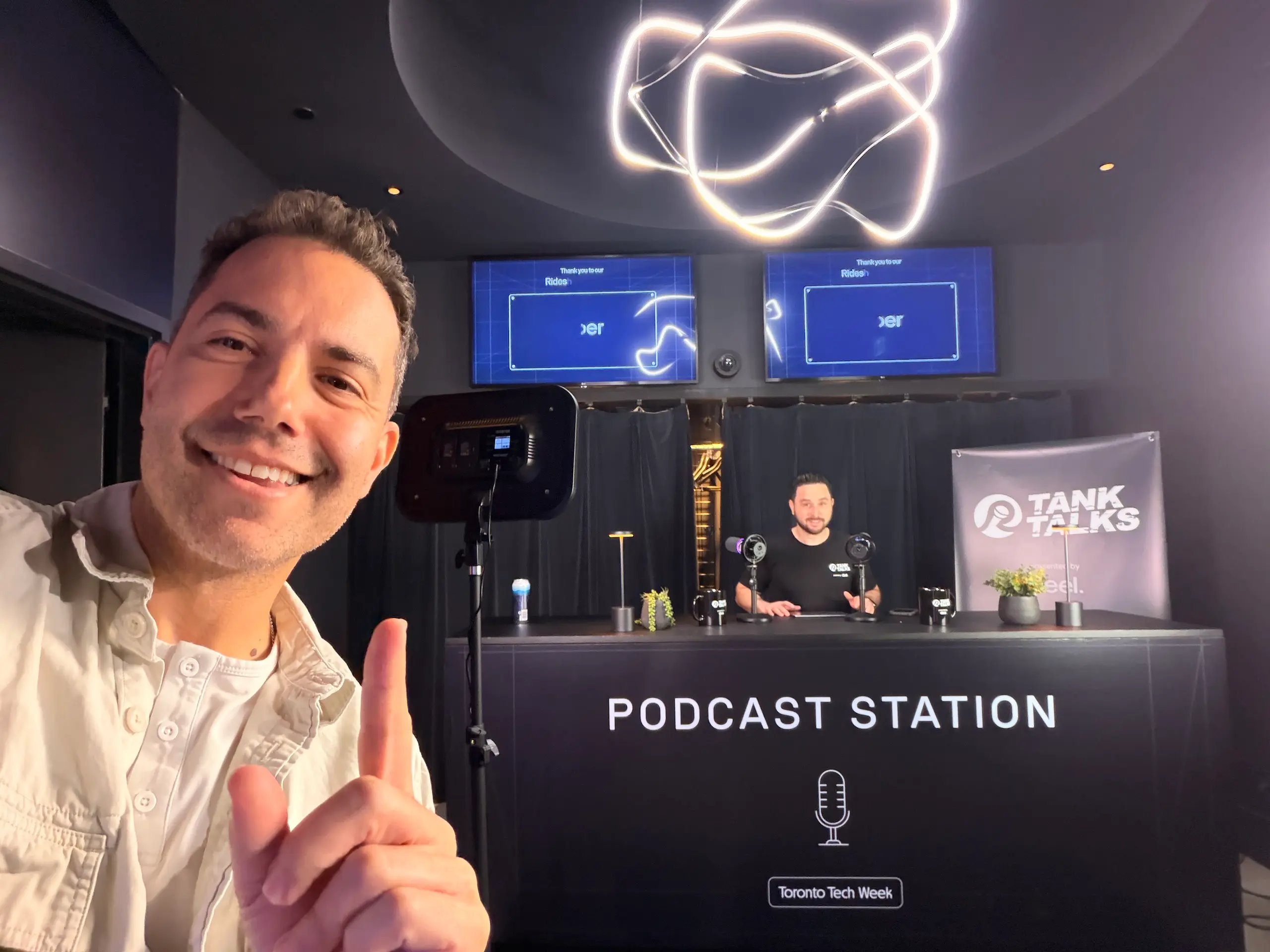
A good sales candidate knows how to give you the answer you want to hear, so we interview like a podcast. Every rep gets taken over the same ground: TAG, which is our shorthand for trust, attitude and grit, plus how they actually sell. We just do it as a conversation, and we come back to each subject a few different ways to see whether the answers line up.
On a sales hire, I'm asking things like: How were you involved in that deal? Who else worked on it, and can I talk to them? Tell me about a sale you lost. Where did you find a way to work less? Asked in a candid conversation, that last one brings things up, and the answer tells you a lot about trust and work ethic.
Then ask them to close you: "If you're a great salesperson, how can you show me this is a really good move for me?" And see them sell before you decide, on a mock call built around your real product and buyer or in a seat at a client meeting. A lot of the decision comes from seeing the person in the role.
I also want to know why they're leaving and what job they'd create for themselves if they could. On top of TAG, a strong salesperson needs curiosity, coachability, a feel for human psychology and a history of hearing no a lot. For a long enterprise cycle, the red flags are frustration and not knowing how to build relationships or bring other stakeholders into a deal.
I'd leave out the personality test. Unless you have evidence its scores predict who sells for you, it's a stalling tactic that protects the hiring team from blame. It also makes you look disorganized to the rep you want.
How Does a Single Decision-Maker Expedite the SaaS Sales Recruitment Process?
You shouldn't need 30 resumes or 30 interviews to make a decision, so we send founders the one candidate we think is right. It's how Don Draper pitches an account he wants to win: he brings one great idea, because 10 would just confuse the client. If the first one misses, a good discovery means the next is close. Usually, companies hire the first person we send them. We're on contingency, so if the quality isn't there, they don't hire and we don't get paid.
A lot of hires fall apart at the very end, when someone who doesn't own the outcome of the role vetoes a great candidate. So settle who makes the final call and who owns the hire before the search starts. If the team starts adding new must-haves halfway through, we pause and have a calibration conversation about what's actually non-negotiable.
Companies sometimes spend months chasing a 10 out of 10 when a strong nine could have been selling for them the whole time. When the right rep is in front of you, be ready to decide that day, the way a sports team that knows what it wants moves first on a free agent. In SHRM's benchmarks for non-executive roles, it's a median of four days from the end of interviews to a decision and an offer. That's four days for a strong rep to say yes to somebody else.
What Are the Best Practices for Onboarding and Retaining Top SaaS Sales Reps?

I'd put at least 90% of a hire's success down to how you onboard and treat them. That starts in the interview, where you lay out the good, the bad and the ugly of the day-to-day so nothing surprises them later. We credit our 96% retention rate at 18 months to the time we spend with clients working out what the role really looks like and coaching them through onboarding. When a hire doesn't work out, blaming the candidate is typically an excuse, because leaders own the environment the new person walks into.
Even then, you're dealing with people, and you can run a million tests and still get it wrong. I recruited a top performer from Microsoft for a biometrics startup. They'd been there about 12 years, wanted a change and thought a startup was right for them, so everything lined up. In the end, the placement didn't work out for the biometrics company. The candidate decided they were a better fit for a bigger organization, left on good terms and went back to Microsoft, which tells you how good they were.
In your position, with a rep seat open today, I'd get everyone who has a vote on the hire into one room. I'd settle those five questions before anyone calls a candidate. Then I'd keep my calendar clear enough to make an offer the day the right rep shows up. If you're in the middle of a sales hire, I'm happy to jump on a quick call and walk through the role and the market with you.
Frequently Asked Questions
How long should it take for a new SaaS account executive to reach full productivity?
Don't expect instant miracles. According to The Bridge Group's 2026 research, the average AE ramp to productivity is 6.2 months. That clock only starts ticking the day they sit down. If your onboarding is messy or your product-market fit is shaky, expect that timeline to drag out even further and burn cash.
If top sales reps aren't applying to job postings, how do we recruit them?
You have to hunt them. Posting a job description and waiting is a losing game. While a LinkedIn survey found 90% of professionals are open to new opportunities, they aren't actively scrolling job boards. You need direct, highly targeted outreach that explicitly pitches the specific growth and commission potential of your seat.
How do we balance equity and cash when recruiting sales leaders for an early-stage startup?
Equity is a sweetener, not a substitute for a competitive base. Top-producing reps have bills to pay. If you leverage equity to heavily discount cash compensation, you'll only attract desperate candidates. Offer a fair market base with aggressive, uncapped commissions, then use equity to lock in their long-term loyalty and grit.
Speed matters, but how do we measure the actual quality of a SaaS sales hire?
Most companies fly blind. In fact, a SHRM benchmark shows only 27% of organizations actually measure quality of hire. For an early-stage sales rep, quality is simple math. Set rigid success metrics before the interview begins, and meticulously track their generated revenue against their base salary and initial ramp-time expectations.
How can local startups compete when US tech giants try to poach our top reps?
You can't outspend a massive US tech company on base salary alone, so stop trying. Win on upside and environment instead. Offer uncapped commissions, faster paths to leadership, and true autonomy. Top performers stay where they see an accelerated trajectory. If you micromanage their pipeline, they will absolutely take the US dollars.