
The best person for your next hire probably isn't going to apply to your job posting. They're employed, they're good at what they do, and they're busy doing it. Getting them on the phone is the easy part of recruiting passive candidates, because about 90% of people are open to a better opportunity when it's presented the right way at the right time. Whether you land one of them in a week or lose them halfway through depends mostly on your side of the table: how clear you are before anyone reaches out, how fast you move once you've met them, and what you do after they sign.
Key Takeaways
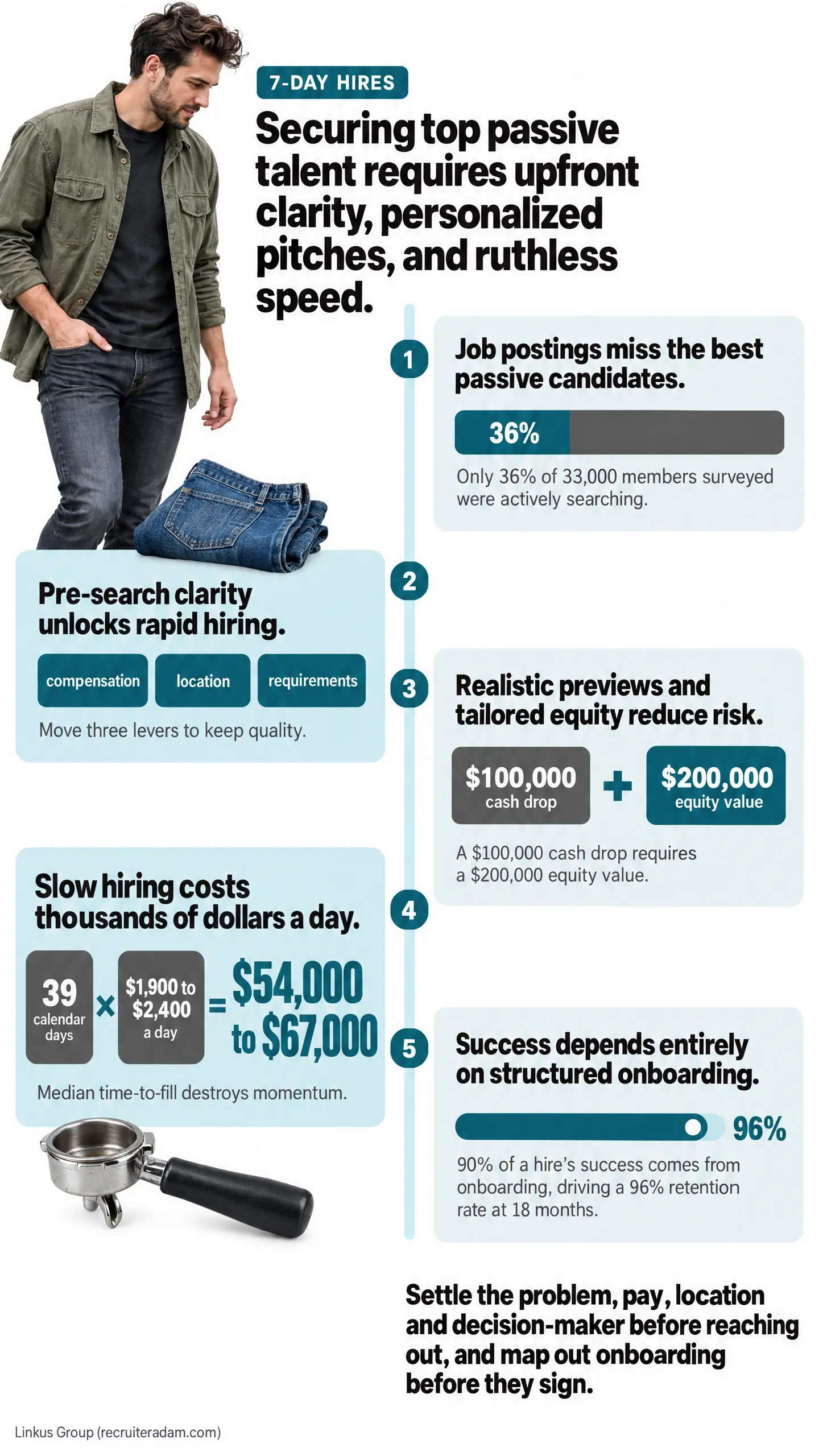
- Relying on traditional job postings restricts startup recruiting to the 36% of professionals actively searching, effectively eliminating the vast majority of high-performing passive candidates.
- Startup recruiters should offer passive candidates an equity package valued at double the base salary they forfeit to offset the inherent financial risk of illiquid private company shares.
- Providing realistic job previews that highlight startup ambiguities significantly reduces recruiting dropout rates and lowers long-term turnover, a conclusion supported by a meta-analysis of 40 studies.
- An unfilled startup position with a $120,000 base salary costs the company approximately $1,900 to $2,400 per day in lost business output.
- Losing a preferred candidate over a $5,000 salary gap costs a company an estimated $10,000 to $12,000 in lost productivity for every subsequent week the role remains empty.
- Startups can accelerate passive recruiting pipelines by strategically adjusting one of three core hiring levers: total compensation, geographic location flexibility, or specific candidate requirements.
- Structured onboarding determines at least 90% of a new hire's success, yielding a 96% retention rate at 18 months for properly integrated startup placements.
Why Are Traditional Job Postings Ineffective for Recruiting Passive Startup Candidates?
Posting a role and waiting is like putting a flyer up in a couple of places and hoping someone walks past your restaurant. You could be going after the people you want and showing them what it's like to work with you. Recruiting is the one department where companies try to throw fewer resources at the problem and still expect to get it right. Posting a job and handling the search internally is the bare minimum, about what you'd get from a salesperson making 10 calls a day, and you wouldn't accept that from your sales team, right?
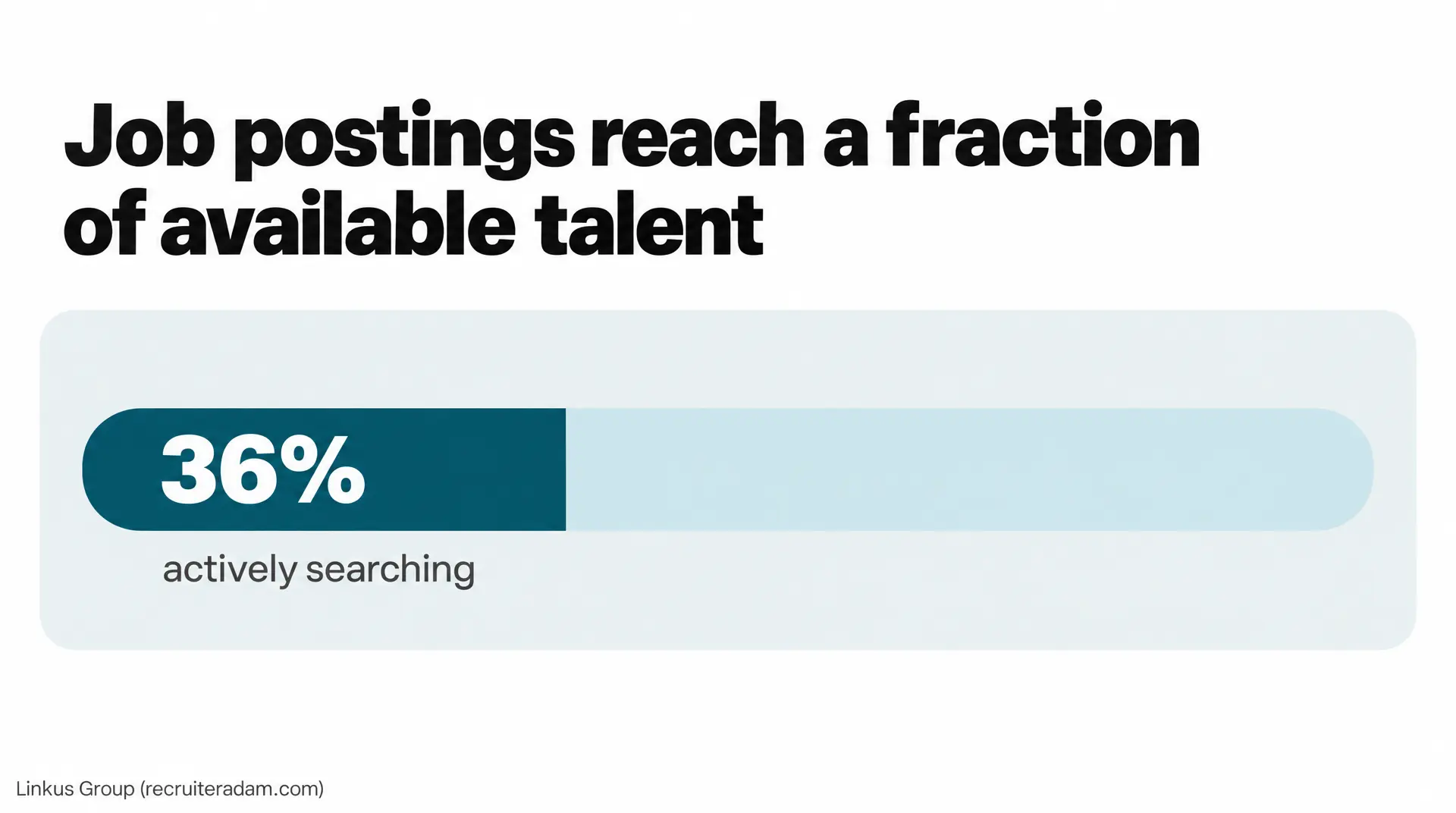
A posting mostly reaches the people who happen to be looking. In a 2016 LinkedIn survey of 33,000 members, only 36% said they were actively searching. Picking from that slice shrinks your pool and builds bias into the search. Job descriptions suck as a way to attract people, and if they worked that way I'd be out of a job. One is still worth writing as an internal tool, to name the business problem and strip out the fluff before anyone gets a call.
In an earlier LinkedIn survey of 18,219 people worldwide in 2013, only 25% were actively or casually looking for a job, while 75% were passive candidates a posting rarely reaches.
|
Candidate type (active or passive) |
Share of professionals |
Reached by a job posting? |
How to recruit them |
|---|---|---|---|
|
Active candidate: actively looking for a job |
12% (global, 2013) |
Yes, the most common way to reach them |
Job postings and job boards |
|
Active candidate: casually looking a few times a week |
13% (global, 2013) |
Sometimes |
Job postings plus direct outreach |
|
Passive candidate: open to talking to a recruiter |
Personal outreach with a short, direct pitch on why the role fits them |
||
|
Passive candidate: reaching out to their personal network |
15% (global, 2013) |
Rarely |
Referrals and outreach from someone they know |
|
Passive candidate: completely satisfied, not looking to move |
15% (global, 2013) |
Rarely |
Personal outreach with a clearly better role at the right time |
How Should Recruiters Structure Initial Outreach to Engage Passive Startup Candidates?

I can't stand it when people say a recruiter had a candidate "in their back pocket." People aren't sitting around waiting for your job. Every candidate is accessible, so finding names is the part anyone can do.
When I reach out to someone who isn't looking, I keep the opener simple, something like: "I've got something great I think you'll want to hear about, and this is why. Are you open to giving me 30 seconds?" The hook changes each time, but it's usually some version of "this job is for you." Keeping them in the process is harder, because you have to confirm it's a fit and give them an experience that makes them want to keep going.
Automated outreach doesn't change that. LinkedIn, AI and scraping tools have each been sold as the answer, and none of them has been a silver bullet. Top performers are less likely to answer a bot than a person they know, someone who's around on a weekend while they make a big decision about their next move. At Linkus Group we use the tools for sourcing and research, and a person owns the conversation and the judgment.
If your list comes from résumé keyword matches, you'll also filter out people worth meeting. The person who does best in a job is usually the one you'd least expect. I persuaded one tech client to interview a CTO candidate whose résumé didn't match their industry. They hired that person, who went on to help them raise their Series A and Series B and later co-founded new ventures with the original team.
How Do Realistic Job Previews and Compensation Structures Attract Passive Startup Candidates?

From the outside, a lot of companies look alike now. If you offer remote work, so do plenty of others, and the same goes for your benefits and your mission. So the pitch has to be about the person you're talking to, and the only way to learn what matters to them is to ask. What would make you leave where you are? Why did you leave your last job? What made you take the one before it? If you could create your next job, what would it look like?
All of that has to line up with the role. For sales candidates, growth is the number one driver. So be crystal clear about the compensation they can actually hit, how the bonus works and where the role leads. If you can't match someone's cash, be just as clear about the trade. A $200,000 candidate who joins you at $100,000 is giving up $100,000 in hard-earned cash. Equity doesn't replace that one for one, since private company shares are often illiquid and resales can be restricted. So I'd build an equity package you'd value at about double what they're giving up, around $200,000 over the vesting period, and I'd tell them upfront that it's a valuation.
Then lay out the good, the bad and the ugly, because the most important part of an interview is getting the person aligned on what the day-to-day looks like. Researchers call this a realistic job preview. A meta-analysis of 40 studies found those previews went along with fewer people dropping out during recruiting, better performance and lower turnover. Someone coming from a big company needs to hear that there's more ambiguity, less budget, fewer people to learn from, and nowhere to hide a mistake. If they've never worked in a startup, let them see it before they confirm, through a trial or by sitting in on a client meeting.
Even with an honest preview, people are human, and the best you can do is reduce your risk. A biometrics company I recruited for hired a top performer who'd spent about 12 years at Microsoft. They wanted to try something new at a startup, so everything seemed to fit. They decided they were better suited to a bigger organization, left on good terms and went back to Microsoft, which tells you how good they were.
What Pre-Search Hiring Criteria Must Startup Teams Define to Accelerate Passive Recruiting?

What kills quality in a fast search is a lack of clarity, and most of the work that makes a one-week hire possible gets done before anyone contacts a candidate. If you didn't add anyone today, would you improve tomorrow? What stops moving if this seat stays empty another month? What can you pay, and where does this person need to sit? Who makes the final call, and who owns this person's results once they start?
Hiring processes frequently fall apart at the very end because the team never agreed upfront who decides. Then someone who doesn't own the outcome vetoes a great candidate. When a hiring committee starts adding new expectations mid-search, we pause and have a calibration conversation to get everyone back on the actual non-negotiables.
You've got three levers you can pull to move fast and keep the quality: compensation, location and requirements. Unwrap It, a small gifting company, needed a full-time head of customer success on a tight budget. We helped them adjust the location, the responsibilities and the skills they were asking for, and that made the role affordable. They hired Sophie, who set up their post-sale engagement processes, unlocked new revenue and took a lot of stress off the team.
Sometimes none of the levers move. One client had really bad Glassdoor reviews, a reputation for working people hard and burned bridges with candidates across its industry. They wanted to underpay for very specific experience. We told them that as much as we'd love to help, they weren't going to get far without changing location, compensation or requirements. If none of those could move, we probably weren't the best fit, and they were welcome to come back if anything changed.
Why Is Rapid Time-to-Fill Critical for Securing Passive Startup Candidates?
I think "hire slow, fire fast" is the biggest lie ever told in hiring. If you hire well you won't need to fire, and if you're slow you'll never find and hire the right person in the first place. At under 250 people, speed is the biggest single asset you've got. Put two coffee shops side by side. The one that knows what it's looking for in a hire, pays a competitive salary and moves faster is going to be the better business.
Time kills all deals, and passive candidates have the least reason to wait. They already have a job, and nothing is pushing them through a long process. Moving slowly tells them you're disorganized and that they aren't a priority. One company won a major bank contract and then lost the project to a competitor. Its interview process wasn't built around the project's timeline, and it couldn't hire the three people it needed fast enough.
To put a number on the wait, divide the salary by 2,000 hours. A $120,000 salary works out to $60 an hour. A good hire should return four to five times their salary. So every hour that seat sits empty costs you about $240 to $300 in output, or roughly $1,900 to $2,400 a day. SHRM's 2026 recruiting benchmark puts the median time-to-fill at 39 calendar days for non-executive roles. That's about 28 working days, or something like $54,000 to $67,000 of output for one seat. It's an estimate, and it leaves out the burnout on whoever's covering the gap, which frequently ends with some of those people leaving too.
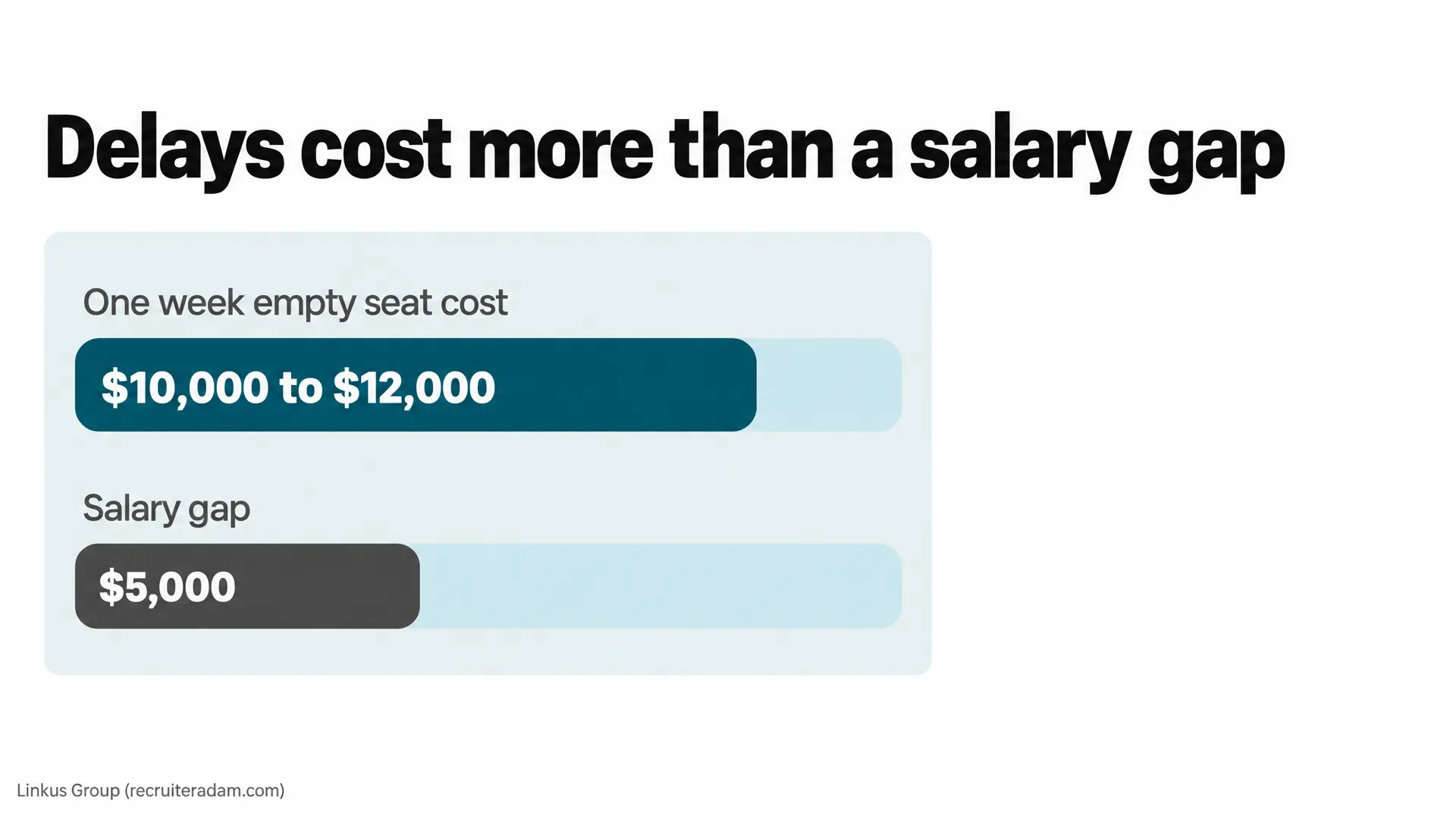
If you're $5,000 apart from a candidate you want, the same math says close the gap. Going back to the drawing board restarts the clock. A single week of that costs roughly $10,000 to $12,000 in output, which is more than the $5,000 costs you in a year.
So cut the extra rounds. Personality tests are mostly a way for a hiring team to avoid blame for a mistake, and to a top candidate they make you look like you don't know what you're doing. I'd rather spend the time on a candid conversation that comes back to the same subject from a few different angles. For grit, I'll ask about a time someone had to work harder than everyone else on their team. Then I'll ask about a time they found a way to work less, and that answer tells you a lot about their work ethic and whether you can trust them. For polish, I'll ask for the email they'd send a vendor to order a thousand pairs of jeans.
We send one highly vetted candidate, framed as "let's see what you think of this person," and usually our clients hire that first person. When Don Draper pitches an account he wants to win, he walks in with one great idea he's confident in, even if it might be wrong, because 10 ideas would only confuse the client. If the discovery was done properly, even a miss is close enough to earn a second shot at someone similar.
We aim to put that person in front of you within 48 hours and complete the placement in under a week. Closing inside the week depends on you being ready to make an offer the moment you're sure, before a competing offer shows up. Some roles and markets are harder and won't fill that fast, but you'll at least have a candidate you're interested in. Executive searches that people expect to take three to six months have taken us as little as two to three weeks. We're on contingency, so if the person we send isn't right, you don't hire them and we don't get paid.
How Does Structured Onboarding Impact the Long-Term Retention of Passive Startup Hires?

In my experience, at least 90% of a hire's success comes from how you onboard and treat them once the offer is signed. Founders who blame a candidate for not working out are usually making an excuse, since leaders own the environment a hire walks into. That matters even more with people you've pulled out of bigger companies, who often expect big-company resources. An 88-person edtech company brought in an executive who crashed and burned because the founder hadn't accounted for how much that person relied on things like a large monthly marketing budget.
Our placements have a 96% retention rate at 18 months. A lot of that comes from the time we spend with founders and their HR people, coaching them through what a new hire will need so neither side gets surprised.
If I were in your seat with a role open today, I'd settle the business problem, the pay, the location and the one person who makes the call before anyone reaches out. I'd decide which lever I'm willing to move if the market pushes back, and I'd keep the week clear enough to meet someone and make an offer the same day. I'd also have their onboarding mapped out before they sign. If you'd like a second set of eyes on the role, I'm happy to jump on a quick call and talk it through.
Frequently Asked Questions
How do employee referrals fit into a passive recruiting strategy?
They are highly complementary. You absolutely do not have to choose between direct outreach and your internal network. LinkedIn's 2016 survey found employee referrals were the leading channel for landing jobs. Warm introductions work perfectly alongside targeted headhunting to close hard-to-reach, high-value candidates quickly.
Should we drop degree requirements to expand our passive talent pool?
Yes, provided the degree isn't absolutely essential to the role. A Harvard Business School report found structural degree-requirement resets in 31% of high-skill roles. Removing arbitrary resume filters helps founders access proven, battle-tested operators who can scale a startup, instantly accelerating your time-to-fill.
How should we evaluate passive candidates if we skip personality tests?
Rely on structured interviews. U.S. Office of Personnel Management data shows structured interviews carry a .51 validity estimate. Pair this approach with a candid conversation about real business constraints rather than putting top-tier talent through bureaucratic hoops that make your startup look disorganized.
What is the business risk of a clunky interview process for passive talent?
It damages your consumer brand and actively costs you top hires. Passive candidates won't tolerate disorganization. According to an iCIMS 2024 survey, 51% of adults said a negative interview experience makes them less likely to be a customer. Move fast and treat them like valued partners.
Do work-sample tests scare off passive startup candidates?
Not if they are highly relevant and respect the candidate's time. OPM data shows work-sample tests boast a .54 validity estimate. The key is making them a brief, realistic preview of the actual job rather than unpaid consulting work, keeping executives engaged while proving their capability.